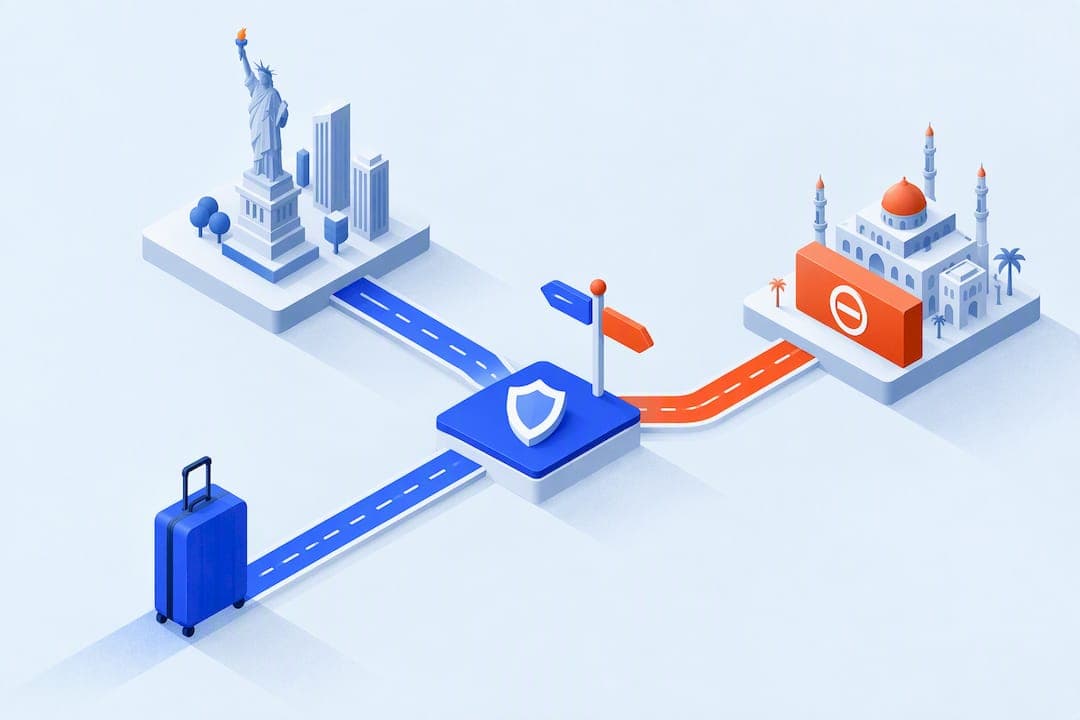
Yes, VPNs are legal in most countries, including the U.S., U.K., Canada, Australia, and every EU member state, but several nations ban or restrict them outright. A VPN never makes illegal activity legal: the laws of wherever you are physically located still apply, and organizations like Freedom House and government security agencies track exactly where the lines sit.
TL;DR:
- VPNs are illegal or heavily restricted in North Korea, Turkmenistan, Belarus, and Iraq, with possession possibly leading to criminal penalties or device seizures.
- Countries like China, Iran, Russia, and Turkey permit VPN use only through government-approved providers, often enforced via network filtering and licensing requirements.
- In nations with legal but enforcement-focused regimes, using a VPN for accessing illegal content or performing unauthorized activities can result in fines, throttling, or legal action, even if the tool itself remains permitted.
- Authorities use deep packet inspection, traffic analysis, and IP blocking to detect and restrict VPN traffic, making obfuscation and server rotation strategies crucial for bypassing restrictions.
- Travelers should install and test VPNs, enable stealth modes, and verify provider privacy policies before arriving in countries with strict VPN laws to minimize legal and technical risks.
Table of Contents
- Why some countries allow VPNs and others restrict them
- Where VPNs are illegal, restricted, or limited
- How authorities penalize and detect VPN use
- A step-by-step checklist for using a VPN while traveling
- What VPNs do and don't do
- Why trust this guide
- How VPN legality has shifted over time
- VPN use for businesses versus individuals
- Personal VPN use versus institutional VPN use
- VPNs and data protection rules like GDPR
- Notable legal cases and provider disputes
- How governments detect and block VPN traffic
- Balancing privacy with lawful caution
- Sources
- FAQ
Why some countries allow VPNs and others restrict them
Most democracies treat VPNs as ordinary security software. Companies depend on them for remote access to internal systems, and individuals use them to keep banking details, passwords, and browsing habits private on public Wi-Fi. Security agencies describe this encrypted tunnel as a baseline privacy tool rather than a loophole, which is one reason governments in Germany and across the EU document VPN use as standard practice for consumers and businesses alike.
Authoritarian and censorship-driven states see the same encryption as a threat to control. A VPN lets a resident route around state content filters, access blocked news outlets, or communicate without easy surveillance, so governments that police information flow tend to restrict the tool itself rather than just the content behind it.
Broadly, countries fall into four regulatory categories:
- Legal and unrestricted: VPNs are treated like any other software, with no registration or approval needed.
- Restricted or approved-only: VPNs are legal only through government-sanctioned providers, often with mandatory licensing.
- Technically blocked: VPNs are not explicitly illegal, but the state uses network filtering to make most services unreachable.
- Outright banned: Possessing or using a VPN is a criminal offense regardless of provider.
Enforcement tactics vary with the category. Approved-only regimes rely on licensing and provider cooperation, while outright bans lean on criminal penalties and device searches. Understanding which bucket a destination falls into is the first step before using a VPN anywhere you don't already live.
Where VPNs are illegal, restricted, or limited
VPN rules split into three practical groups: places where the tool itself is criminalized, places where only approved versions are legal, and places where VPNs are legal on paper but enforcement still creates risk.
Outright bans. North Korea, Turkmenistan, and Belarus prohibit VPN use entirely, and Iraq restricts VPNs as part of broader internet controls. In these countries, possession of VPN software can itself be treated as a criminal act, independent of what the software was used for. Enforcement typically combines network-level blocking with the threat of prosecution for anyone caught bypassing it, and in North Korea's case, unauthorized foreign communication tools carry some of the harshest penalties anywhere.
Restricted or government-approved only. China, Iran, Russia, and Turkey permit VPNs only through state-sanctioned channels. China's approach is the most developed: businesses can apply for licensed VPN access, but consumer-grade VPNs sold outside that system are routinely blocked at the network level, and the practical traveler advice is to install and test a VPN before arrival since app stores inside the country may not offer it. Russia has tightened its stance in recent years, with rules requiring providers to register or retain logs, and unapproved services face coordinated blocking. Iran restricts VPNs to licensed domestic providers, which effectively hands the government visibility into traffic that would otherwise be private. Turkey blocks a long list of VPN services tied to its broader content-filtering regime, though enforcement against individual users remains inconsistent.
Legal but enforcement-targeted. The UAE, India, Egypt, and Uganda allow VPNs for general use, but specific activities turn a legal tool into a legal problem. The UAE permits VPNs for business and banking but criminalizes using one to access blocked content or to commit fraud, with penalties that can include fines. India does not ban VPNs, but 2022 data retention rules require providers to log user information for a set period, which has pushed some privacy-focused services to withdraw servers from the country entirely. Egypt and Uganda both tolerate VPN use broadly but have, at times, pressured providers or throttled traffic around politically sensitive events such as elections.
- Install before you fly: app stores in restricted countries often remove VPN apps, so download and activate your service while still on home soil.
- Check the activity, not just the tool: a legal VPN can still land you in trouble if it is used to access content that is independently illegal in that country.
- Expect inconsistency: enforcement in the "restricted" and "limited" groups often targets providers and high-profile cases rather than every individual user, but that inconsistency is not a guarantee.
How authorities penalize and detect VPN use
Penalties for VPN violations span a wide range. At the lighter end, a country might issue a fine or temporarily suspend an account tied to unauthorized use. At the more severe end, authorities in outright-ban countries can pursue device seizure or, in the most extreme cases, imprisonment, particularly when VPN use is tied to another alleged offense such as distributing banned political content.
Detection relies on both technical and legal tools. Deep packet inspection (DPI) lets network operators flag traffic patterns typical of encrypted VPN tunnels, even without decrypting the contents, and is one of the primary methods security agencies document for identifying VPN use. Governments also pair DPI with:
- IP and server blocklists that cut off known VPN endpoints at the network level.
- App-store takedown requests, forcing VPN providers off local app marketplaces.
- Legal demands on providers, compelling them to hand over logs or register with a regulator.
Enforcement varies widely by country and tends to target providers and high-profile cases more often than individual users, with penalties ranging from fines to app-store blocking to, in extreme cases, imprisonment. That unevenness means the same VPN use could be a non-issue in one country and a serious legal exposure in another, which is exactly why checking a destination's specific rules matters more than relying on a general sense of "VPNs are fine."
A step-by-step checklist for using a VPN while traveling
Reducing legal and operational risk when using a VPN abroad comes down to preparation, not improvisation.
- Check official guidance first. Consult government travel advisories and credible outlets like Freedom House's country reports before you assume a VPN is safe to use.
- Install and test before you arrive. Download your VPN app, confirm it connects, and save offline setup instructions while you still have reliable access to app stores and your home network.
- Enable obfuscation or stealth mode where needed. In restricted countries, a standard VPN connection can be detected and blocked by DPI, so switch on obfuscated servers designed to disguise VPN traffic as regular web traffic. Our guide to VPN protocols breaks down which protocols support this.
- Turn on a kill switch. This cuts your internet connection if the VPN drops, preventing your real IP address from leaking at a moment you might not notice.
- Set up multiple devices in advance. If your phone's connection fails, having a laptop or tablet pre-configured with the same service gives you a backup.
- Choose a provider with a verifiable track record. Look for audited no-logs policies, a jurisdiction outside aggressive data-sharing alliances, a broad server footprint, and published transparency reports. Our breakdown of free VPN risks explains why unaudited free services are a poor fit for this kind of travel.
- Know when to simply not use one. If you're heading somewhere with a clear outright ban and severe penalties, such as North Korea, the safest choice is to leave the VPN at home and never attempt to bypass the restriction. A VPN should never be your tool for accessing content that's independently illegal or for committing a crime, regardless of where you are.
Pro Tip: Test your VPN's obfuscated servers on a stable home connection before you travel: some stealth modes slow speeds noticeably, and it's easier to pick a faster alternative server in advance than mid-trip. Our VPN speed testing guide walks through how to check this yourself.
What VPNs do and don't do
A VPN encrypts the traffic between your device and its server, and masks your IP address from the websites and networks you connect to. That's a real privacy upgrade at the network and internet-service-provider level, but it has limits that matter legally.
- A VPN doesn't anonymize everything you do. Logging into your email, bank, or social media accounts inside the encrypted tunnel still identifies you to those services.
- A VPN doesn't override a lawful subpoena. Providers that keep logs, or that operate in jurisdictions with data-sharing agreements, can be compelled to hand over records.
- A VPN doesn't make illegal activity legal. Crimes committed while connected remain crimes, and using a VPN as a tool doesn't shield the underlying offense from prosecution.
- A VPN doesn't override a streaming service's terms of service. Using one to access a region-locked catalog typically violates the platform's terms, which is a contractual issue rather than a criminal one, but it can still get an account suspended.
Jurisdiction matters because it determines what a provider can legally be forced to disclose, which is why audited no-logs policies and the provider's home country are worth checking before you rely on one abroad.
Why trust this guide
This guide draws on government and security-agency documentation, independent censorship reporting, and vetted technology journalism rather than marketing claims from any single VPN brand. Top10VPNs backs its recommendations with a few concrete standards:
- Independently audited no-logs claims, so a provider's privacy promises are verified rather than taken on faith.
- A money-back guarantee on recommended services, giving readers room to test a provider risk-free.
- Reader-supported, independent reviews, with editorial judgments kept separate from any commercial relationship.
For the legal facts in this guide specifically, we rely on BSI's consumer security guidance, Freedom House's Freedom on the Net reporting, and established technology outlets. Laws change, so always verify current rules with an official government source before you travel.
How VPN legality has shifted over time
VPNs started as a corporate tool in the 1990s, built to let employees connect securely to internal company networks from outside the office. For most of their early history, no government paid them much legal attention because the audience was businesses, not the general public.
That changed as consumer VPN services grew through the 2010s, coinciding with rising public awareness of government surveillance and internet censorship. As ordinary people began using VPNs to protect privacy or bypass content restrictions, censorship-heavy governments started treating the tools as a threat rather than a footnote. Freedom House's reporting on internet freedom tracks how this period saw a wave of new restrictions in authoritarian states, often timed to elections, protests, or political transitions.
The trend hasn't stopped. Countries continue to adjust VPN rules in both directions: some tighten registration and data-retention requirements, as India did with its 2022 rules, while others loosen restrictions as part of broader digital-economy reforms. Even in democracies, regulatory debates, such as proposals tied to online age-verification and safety rules, can create short-term uncertainty about how VPN use fits into new frameworks, even when the tool itself remains legal. The practical lesson is that a country's VPN stance from even a few years ago isn't guaranteed to hold today.
VPN use for businesses versus individuals
Businesses and individuals are rarely regulated by the same rules, even in countries with tight VPN restrictions. Licensed, government-approved VPN regimes, like the ones in China and Iran, often carve out specific allowances for registered companies that need secure remote access, provided the business applies through the proper channel and uses an approved provider.

Individual consumer use sits on shakier ground in those same countries. A business traveler connecting to a company's licensed VPN for work faces a different risk profile than a tourist installing a consumer VPN app to stream content or browse social media. The approved-only category exists largely because governments want to preserve the economic necessity of secure business connections while still controlling the general population's access to unrestricted information.
This distinction also shows up in enforcement patterns. Authorities pursuing VPN violations tend to focus on individual consumer use, unregistered apps, and high-profile public cases rather than the corporate VPN traffic running through officially sanctioned channels. If you're traveling for work and your employer provides a VPN connection as part of standard IT policy, that setup is generally treated differently than installing your own personal VPN app for browsing.
Personal VPN use versus institutional VPN use
Beyond the business-versus-individual split, there's a further distinction between personal VPN use and institutional use by governments or large corporate networks. Institutional VPNs, like the ones government agencies or multinational corporations run, typically operate as closed, permissioned systems: only authorized staff with the right credentials can connect, and the entire network is usually hosted or licensed under the organization's own legal arrangements with regulators.
Personal VPN use, by contrast, is a consumer buying a subscription from a public-facing provider and installing an app on a personal device. This is the category that most restrictive laws target, since it's the layer where ordinary individuals bypass state content controls or access region-locked services. Institutional VPNs rarely face the same scrutiny because they operate within pre-approved legal structures and serve a defined, accountable user base rather than the general public.
The practical takeaway for an everyday reader is straightforward: if you're using a personal VPN subscription rather than a corporate or government-issued one, you fall into the category that most restrictive countries are actually trying to regulate, so the country-specific guidance in this guide applies directly to you.

VPNs and data protection rules like GDPR
VPN use intersects with privacy regulation in two distinct ways: how VPN providers themselves must handle user data, and how VPN use affects an individual's own data protection rights.
Providers operating in or serving the European Union fall under the GDPR's requirements for data handling, which means any logs they do keep, such as billing information or limited connection metadata, must be processed according to GDPR's consent, minimization, and security standards. This is part of why a provider's jurisdiction matters: a VPN company based outside the EU isn't automatically bound by GDPR unless it's processing data tied to EU residents.
For individuals, a VPN can be a practical tool for exercising data protection preferences, such as limiting how much browsing activity is visible to an internet service provider or a local network operator, but it doesn't replace the legal protections GDPR already provides EU residents, like the right to access or delete personal data held by a company. A VPN changes who can see your traffic in transit. It doesn't change what rights you have over data a service provider already holds about you.
Notable legal cases and provider disputes
Legal friction around VPNs tends to show up in two forms: disputes over whether a provider must comply with government data demands, and enforcement actions against individuals caught in more restrictive regimes.
On the provider side, the central tension documented in VPN industry coverage is between no-logs policies and government pressure to retain or disclose user data. Russia's regulatory approach has included requiring providers to register and, in some cases, retain logs or risk being blocked entirely, a pattern that has pushed several providers to withdraw services from the country rather than comply.
On the individual side, enforcement in outright-ban and restricted countries tends to surface in connection with other alleged offenses, such as distributing banned political content or operating unlicensed business activity, rather than prosecuting VPN use as a standalone act in isolation. This pattern reinforces a point worth repeating: the legal exposure from VPN use is often tied to what the VPN was used for, not merely the fact that one was running.
How governments detect and block VPN traffic
Deep packet inspection is the best-known detection method, but it's not the only one. Governments and network operators also use:
- Traffic pattern analysis, which flags connections with the timing and volume characteristics typical of VPN tunnels even when the specific protocol can't be identified.
- Active probing, where a network operator's systems attempt to connect to a suspected VPN server the way a real client would, confirming its identity before adding it to a blocklist.
- TLS fingerprinting, which examines the handshake characteristics of an encrypted connection to distinguish VPN traffic from ordinary HTTPS browsing.
- Coordinated IP blocklisting, where authorities maintain and update lists of known VPN server addresses, often faster than individual providers can rotate them.
VPN providers counter these measures with obfuscation technology that wraps VPN traffic in a layer designed to resemble standard HTTPS traffic, making it harder for DPI and pattern analysis to flag it. Some services also rotate server IP addresses frequently or use shared IP pools to stay ahead of blocklists. This is an ongoing technical back-and-forth rather than a solved problem: a method that works well in one country's network environment may be detected and blocked within months in another, which is part of why checking a provider's current obfuscation capabilities matters more than relying on general reputation.
Balancing privacy with lawful caution
VPNs are genuinely useful for privacy in contexts most people never think about, from securing a hotel Wi-Fi connection to keeping a home network's traffic private from an internet provider. That value doesn't mean every situation calls for one without a second thought.
Where laws are unclear or enforcement has a history of targeting individuals, I'd rather see a reader choose caution and an audited, transparent provider than assume a VPN is automatically safe everywhere. Check our best VPN comparisons when you're ready to weigh providers against your own travel plans and privacy needs.
— Secure
Sources
Laws around VPN use shift without much public notice, so treat the following as a starting point rather than a final word, and confirm current rules before you travel or rely on a VPN somewhere new.
- Is a VPN Legal? Where VPNs Are Allowed and Banned | Webopedia
- Are VPNs legal? | Engadget
- Virtual private networks (VPNs) | BSI
- Are VPNs legal? | TechRepublic
- Freedom on the Net reports | Freedom House
FAQ
Can using a VPN get you in trouble?
In most countries, no, since VPN use itself is legal. In countries with outright bans or approved-only regimes, such as North Korea, Turkmenistan, Belarus, and Iraq, using an unauthorized VPN can lead to fines, device seizure, or more severe penalties.
Is it legal to use a VPN for Netflix?
Using a VPN itself is legal almost everywhere, but accessing a region-locked streaming catalog with one typically violates the platform's terms of service. That's a contractual issue between you and the streaming service, which can lead to account suspension, rather than a criminal law problem.
Can police track VPN use?
Authorities can sometimes detect that a VPN is in use through methods like deep packet inspection and traffic pattern analysis, even without seeing the content inside the encrypted tunnel. Whether they can tie that traffic to your specific activity usually depends on the provider's logging policy and its jurisdiction's legal cooperation agreements.
Will I get banned for using a VPN?
Some services, particularly streaming platforms and certain websites, detect and block known VPN IP addresses, which can interrupt access rather than result in a permanent ban of your account in most cases. Repeated terms-of-service violations tied to VPN use can occasionally lead to account suspension on platforms that explicitly prohibit the practice.
Where are VPNs completely illegal?
VPNs are banned outright in a small number of countries, including North Korea, Turkmenistan, Belarus, and Iraq. Other countries like China, Iran, and Russia restrict VPN use to government-approved providers rather than banning the technology entirely.